


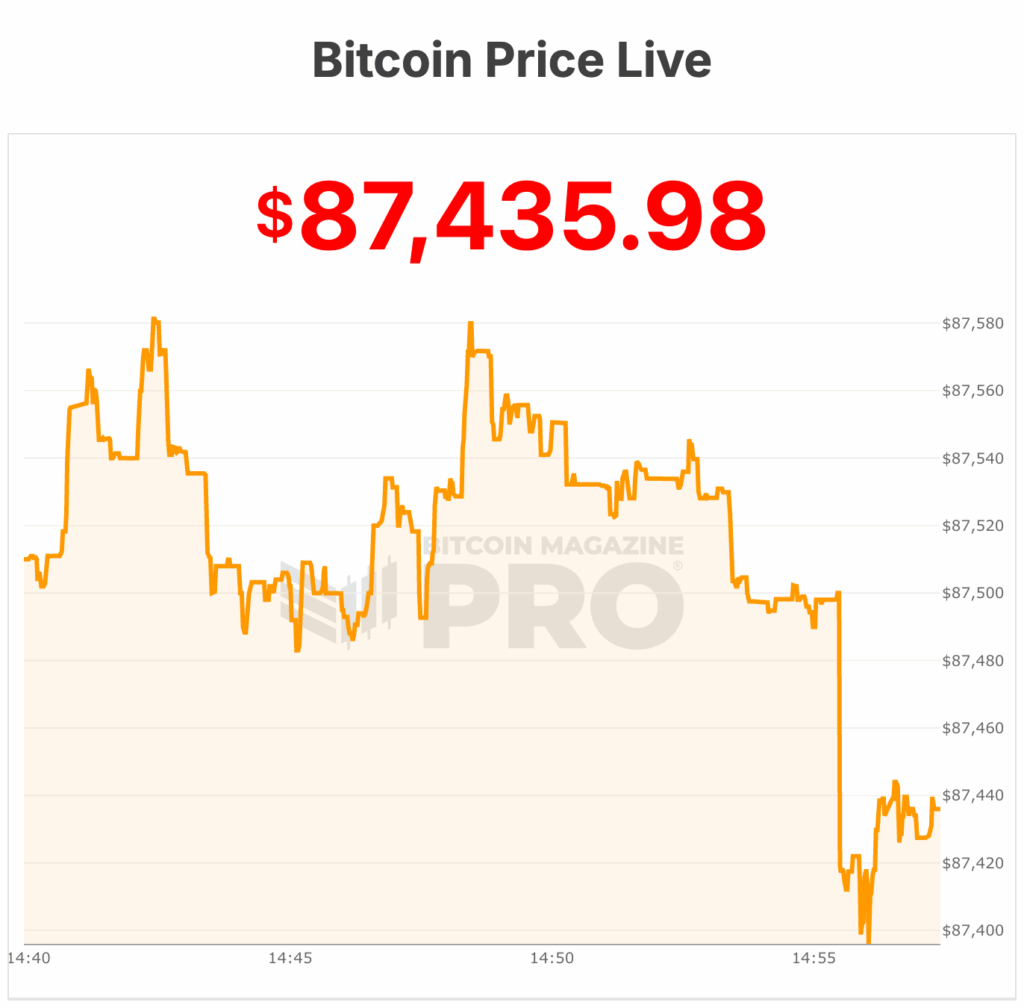
As 2025 draws to a close, Bitcoin is positioned near $87,000, reflecting a year characterized by a narrow trading range and diminishing momentum. The market’s drift into the year’s final trading session can be attributed to thin holiday liquidity coupled with a lack of substantial catalysts. This culminated in a year marked more by consolidation than by explosive gains, with expectations largely unmet.
At the time of this report, Bitcoin was trading just below $88,000, exhibiting little movement over the past week and registering a modest decline from the year’s beginning. Throughout December, the price oscillated between the low and high $80,000s, with unsuccessful attempts to reclaim the $90,000 mark lacking in sustained momentum.
This subdued year-end performance contrasts sharply with the optimism that characterized the beginning of 2025. Bitcoin commenced trading in January at approximately $95,000, bolstered by strong inflows into spot Bitcoin exchange-traded funds (ETFs), increased institutional engagement, and expectations that a more accommodative monetary policy would elevate risk assets.
Initially, these narratives appeared promising.
Bitcoin experienced a notable rally during the first half of the year, driven by sustained ETF demand and ongoing accumulation by corporate treasuries and long-term holders. This upward trend culminated in October, when Bitcoin temporarily surged to a new all-time high exceeding $125,000, a movement fueled by improving macroeconomic sentiment, strategic positioning ahead of anticipated interest rate cuts, and renewed speculative interest in derivatives markets.
However, this rally proved to be ephemeral. As the fourth quarter unfolded, tightening financial conditions, rising bond yields, and a stronger dollar adversely impacted risk appetite. Consequently, Bitcoin retraced alongside equities and other growth assets, relinquishing a substantial portion of its prior gains.
By early December, Bitcoin’s price had declined by more than 30% from its peak, returning to a trading range that had predominantly defined the year’s activities.
Macro Pressures Persist for Bitcoin
Macroeconomic factors played a pivotal role in shaping Bitcoin’s performance throughout 2025. Persistent inflation led many investors to predict that central banks would adopt a restrictive stance for longer than anticipated.
This environment favored cash and yield-bearing assets over speculative investments, thereby constraining upside potential across the cryptocurrency markets. Bitcoin, typically perceived as a hedge against monetary debasement, struggled to engage marginal buyers while real yields remained elevated.
The liquidity conditions further deteriorated as the year concluded. December witnessed a significant decline in trading volumes as market participants withdrew for the holiday season.
With fewer active buyers and sellers, price movements became increasingly volatile, and market conviction waned. The absence of strong inflows into spot ETFs during the year’s final weeks amplified this cautious sentiment.
On-chain data echoed this narrative, indicating that long-term holders largely remained inactive, while short-term traders predominated transaction flows, contributing to range-bound price behavior. Large holders curtailed aggressive accumulation following the October peak, whereas retail participation saw an uptick during price pullbacks, a trend consistent with consolidation rather than a formation of a new trend.
Nevertheless, 2025 was not devoid of structural advancements for Bitcoin. The market continued to mature, evidenced by deeper liquidity in derivatives, enhanced custody solutions, and increased integration into traditional financial frameworks.
Spot Bitcoin ETFs concluded the year with assets under management totaling tens of billions of dollars, establishing a new cohort of long-term demand even amidst fluctuating short-term flows.
Bitcoin also retained its status as the preeminent digital asset, significantly outperforming most alternative cryptocurrencies on a relative basis. Although it did not match the strong performance of gold during periods of macroeconomic stress, Bitcoin remained one of the most liquid and widely traded assets worldwide, reinforcing its position as the benchmark for the broader cryptocurrency market.
As Bitcoin transitions into 2026, attention is increasingly focused on whether the prolonged consolidation will resolve favorably. Traders are monitoring the $90,000 level as a critical psychological and technical barrier, while support in the low $80,000s continues to hold.
A meaningful shift in macroeconomic conditions, renewed inflows into ETFs, or a resurgence in institutional accumulation could serve as potential catalysts to break the current stalemate.
For the time being, Bitcoin embarks on the new year in a subdued state, trading around $87,000 and in search of directional clarity.

Thank you for visiting our site. You can get the latest Information and Editorials on our site regarding bitcoins.

