


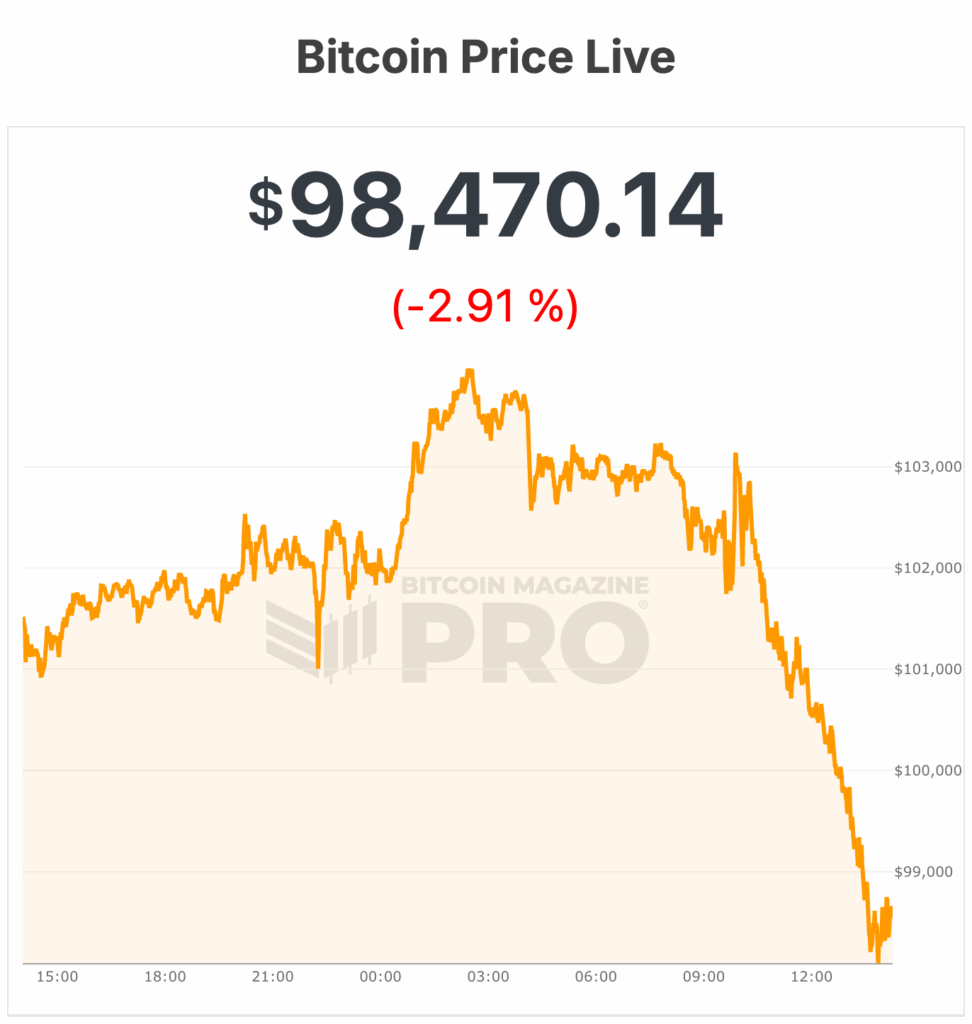
Today, the price of Bitcoin experienced a significant decline, dropping from an intraday peak of $104,000 to $98,113. This sharp decrease effectively erased prior gains and signified a pivotal breakdown in market trends.
Throughout the morning trading session, Bitcoin’s valuation steadily diminished from the high $102,000s, ultimately reaching a low of $97,870.
A potential factor contributing to this downturn may be attributed to long-term holders liquidating their assets at unprecedented rates. Data from CryptoQuant reveals that approximately 815,000 BTC have been sold in the past 30 days—the highest volume recorded since early 2024—while demand in both the spot and ETF markets has diminished. Profit-taking has been predominant, with $3 billion in realized gains occurring on November 7 alone.
Analysts at Bitfinex have noted that the current Bitcoin pullback resembles prior mid-cycle retracements. The recent decline from October’s peak aligns with a typical 22% drawdown witnessed throughout the 2023–2025 bull market.
Furthermore, according to The Block, analysts from JPMorgan have indicated that the current estimated production cost of Bitcoin, approximately $94,000, serves as a historical price floor, suggesting limited downside potential.
These analysts contend that increasing network difficulty has driven production costs higher, keeping Bitcoin’s price-to-cost ratio at historically low levels. They maintain an ambitious upside projection for the next 6 to 12 months, estimating Bitcoin’s value could reach around $170,000.
This analysis occurs against the backdrop of the U.S. government reopening after a record 43-day shutdown—marking the longest government closure in history—prompted by President Trump’s recent signing of a funding bill.
Although federal operations are resuming, the recovery process is anticipated to be gradual. Federal employees are still awaiting back pay, and there may be continued air travel delays.
Agencies such as the IRS are confronting significant backlogs, while national parks are struggling to recuperate lost revenue. The short-term funding measure currently extends only until January 30, leaving the possibility of another government shutdown looming.
The path to a return to normalcy is expected to take time, as the effects of the prolonged closure continue to reverberate through the economy and public services.
Bitcoin’s price initially surged in October, coinciding with the onset of the government shutdown, reaching new all-time highs exceeding $126,000. However, this excitement was short-lived as the Bitcoin market began to exhibit volatility throughout the remainder of October and into November.
At the time of this writing, Bitcoin’s price stands at $98,470.
Despite a generally positive sentiment in the market, the price of Bitcoin has continued to descend deeper into the month.
Bitcoin Price Correlation with Nasdaq: A Detrimental Trend
Bitcoin remains closely correlated with the Nasdaq; however, it has begun to demonstrate an atypical pattern: it tends to react more sharply to declines in the stock market than to gains, as highlighted in a recent report by Wintermute.
This “negative skew”—where losses are more pronounced during negative equity days than gains during positive ones—is usually observed in bear markets, rather than in circumstances where BTC is near all-time highs. This behavior suggests a sense of investor fatigue rather than euphoria.
Two primary factors appear to be influencing this trend. First, attention and capital have shifted toward equities in 2025, with major tech and Nasdaq growth stocks absorbing a significant portion of the risk appetite that might otherwise have been directed towards cryptocurrency. Consequently, while Bitcoin reacts proportionately when the market falters, it does not experience the same uplift during recovery periods, behaving more like a high-beta asset in the face of macroeconomic risks.
Second, liquidity in the cryptocurrency sector has declined compared to previous periods. The issuance of stablecoins has stagnated, inflows into ETFs have slowed, and the depth of exchanges has not fully recovered. These circumstances contribute to more marked declines and a widening performance gap.
Nevertheless, Wintermute asserts that Bitcoin has maintained relative resilience. Even with a persistent downward bias, it remains less than 20% below its all-time high. This pattern, while unusual near market peaks, may also reflect Bitcoin’s maturation as a macro asset.

Thank you for visiting our site. You can get the latest Information and Editorials on our site regarding bitcoins.

