


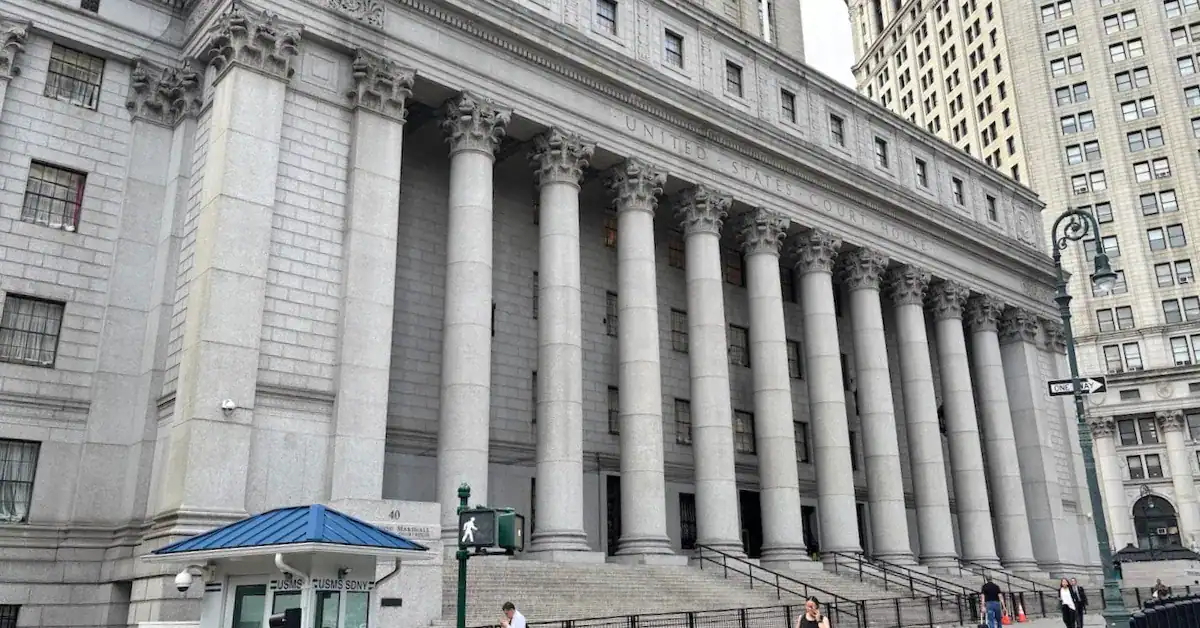
On the second day of the Tornado Cash trial, the prosecution and defense presented contrasting narratives in their opening statements regarding the motivations behind Roman Storm’s establishment of Tornado Cash.
SUMMARY OF DAY 2 OF TORNADO CASH TRIAL
The prosecution and defense deliver opening statements, and the first witness takes the stand… pic.twitter.com/ZIKt3SE2ZP
— Frank Corva (@frankcorva) July 15, 2025
These statements were delivered following the conclusion of the jury selection process.
The jury comprises seven women and five men, including two members in their 60s, four in their 40s, one in their 30s, and five in their 20s. Educationally, eight members possess undergraduate degrees, three have high school diplomas, and one has a master’s degree.
The jurors took their places just before 2:00 p.m. EST, immediately preceding the opening statements from both sides.
Opening Statement from the Prosecution
Mr. Mosley, representing the prosecution, commenced with the assertion that Storm initiated Tornado Cash primarily for personal financial gain, even if it involved facilitating the laundering of illicit funds.
He claimed that hundreds of millions of dollars’ worth of cryptocurrency had been routed through Tornado Cash and contended that Storm and his co-conspirators, Roman Semenov and Alexey Pertsev, could have implemented safeguards to deter criminal use but opted not to do so.
Furthermore, Mr. Mosley cited instances where Tornado Cash was used for sanctions violations, specifically referencing North Korean hackers laundering stolen funds through the service.
He suggested that Storm’s guilt is evident from his own communications, particularly a text message wherein he expressed, “Guys, we’re done for,” upon learning of the service’s misuse, as well as an instance where Storm donned a T-shirt emblazoned with a washing machine and the Tornado Cash logo at a crypto conference. The defense later acknowledged that wearing such a T-shirt was indeed in “poor taste.”
According to Mr. Mosley, evidence will demonstrate that Storm and his co-conspirators knowingly operated a cryptocurrency “washing machine” for illicit actors, countering their claim of being unable to make modifications to Tornado Cash’s design once aware of its misuse.
“He chose to launder money time after time,” Mr. Mosley stated, emphasizing Storm’s alleged culpability.
He also pointed out that Storm purportedly attempted to conceal his actions by cashing out millions through an account not in his name, although specifics regarding this account were not disclosed.
Mr. Mosley concluded by indicating that evidence would include encrypted communications related to Tornado Cash as well as documentation revealing Storm’s alleged use of another’s account for transactions in August 2022.
Opening Statement from the Defense
Following the prosecution, Ms. Axel of the defense team addressed the jury, portraying Storm as a diligent immigrant with a strong background in computer programming, having worked for notable technology firms, including Amazon.
Ms. Axel argued that Storm’s creation of Tornado Cash was motivated by a desire to enhance financial privacy in public blockchain transactions, firmly stating that he had no affiliation with any of the malicious actors exploiting the platform.
“Roman had nothing to do with the hacks and scams that the government cited,” Ms. Axel declared. “Bad actors misused Tornado Cash to obscure their identities.”
She recounted an inspiring conversation between Storm and Vitalik Buterin, the creator of Ethereum, which prompted Storm to develop Tornado Cash. According to Ms. Axel, Buterin indicated that transactional privacy represented a crucial issue that required addressing.
Ms. Axel effectively illustrated how Ethereum operates and the mechanism by which Tornado Cash anonymizes transactions on the platform, though the implications may have been somewhat complex for jurors lacking technical backgrounds.
She underscored Tornado Cash’s lack of transaction fees, highlighting its nature as a tool intended for both beneficial and illicit purposes, similar to communication platforms or utilities.
Furthermore, she addressed the transparent nature of Tornado Cash’s development processes, noting that once the mixing pools were operational, Storm and his team relinquished control by burning the access keys.
“The government’s case hinges on the premise that Roman should have prevented hackers from utilizing the pools,” Ms. Axel contested. “Such an expectation is unrealistic.”
Ms. Axel concluded by asserting that Tornado Cash is merely a cryptocurrency mixing tool, which can be wielded by both good and bad actors alike.
The First Witness
Following the opening statements, the prosecution called Ms. Lin to the stand as its first witness.
Ms. Lin described an encounter in which a scammer contacted her through messaging platforms, persuading her to create a Crypto.com account and deposit over $200,000. The testimony indicated that the funds were subsequently funneled to a shell entity, NTU Capital, where she monitored her portfolio’s appreciation.
Although the witness was excused before providing a complete account, it can be inferred, given the trial’s context, that her funds may have been appropriated and laundered through Tornado Cash—though this remains speculative.
Tomorrow’s Schedule
The trial is scheduled to reconvene tomorrow at 9 a.m. EST, with the prosecution indicating plans to present at least three additional witnesses.
This article, titled “Tornado Cash Trial Day 2: Prosecution and Defense Present Divergent Narratives Regarding Roman Storm,” was originally published on Bitcoin Magazine by Frank Corva.

Thank you for visiting our site. You can get the latest Information and Editorials on our site regarding bitcoins.

