


Bull Bitcoin, an exchange recently licensed under the Markets in Crypto-Assets (MiCA) framework, is pursuing a legal challenge in French courts against a European directive that establishes a comprehensive surveillance database, potentially endangering millions of cryptocurrency users.
Bull Bitcoin, recognized as the world’s oldest Bitcoin-only and non-custodial exchange, has filed a legal challenge with the Conseil d’État, France’s supreme administrative court. This action seeks the annulment of Decree No. 2025-1276, a principal regulatory framework implementing the European DAC8 directive into French law, alleging that it facilitates the creation of a vast surveillance network and database. This development poses risks of data leaks and hacks, thereby endangering civilians’ safety, including the potential for kidnapping and other forms of physical harm.
In conjunction with its legal efforts, the company has launched dac8.com, described as “a comprehensive, fully sourced resource for citizens, journalists, and policymakers,” as indicated in a press release distributed to Bitcoin Magazine.
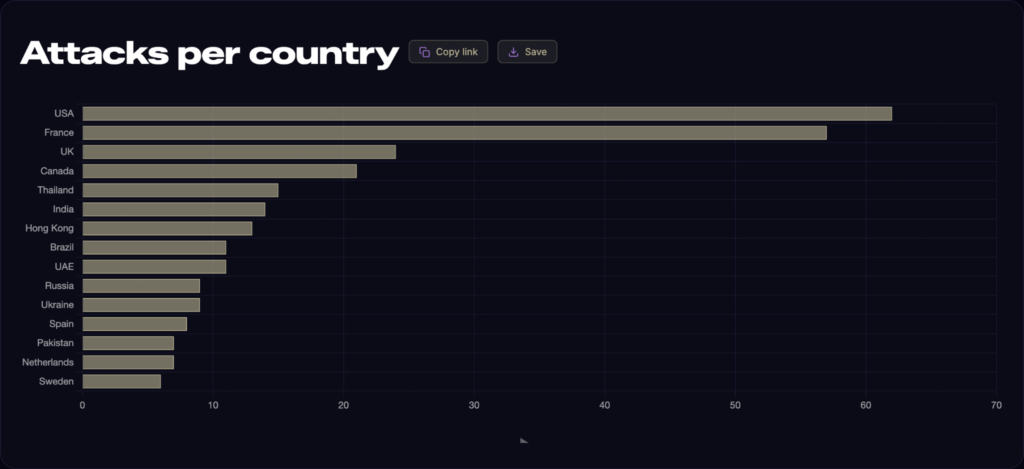
There has been a concerning increase in kidnappings and physical assaults targeting cryptocurrency users, primarily in Europe, with France identified as a focal point. Criminal enterprises are reportedly leveraging inadequate data reporting frameworks to exploit law-abiding crypto users who disclose their asset ownership through tax compliance. Given the non-reversible nature of Bitcoin and other cryptocurrencies and their ease of international transfer, criminals are specifically targeting these individuals. According to data from Gart, a company dedicated to safeguarding users from these threats, France ranks second in terms of physical assaults on crypto users, following the United States, despite the latter having a significantly larger population.
Prominent figures within the Bitcoin and broader cryptocurrency landscape have also faced targeted attacks in recent years, including Binance France CEO David Prinçay and Ledger co-founder David Balland, the latter of whom sustained a serious injury during an incident. Jameson Lopp, co-founder of Casa, which specializes in high-security Bitcoin and Ethereum wallets, has maintained a database on GitHub cataloguing ‘wrench attack’ incidents, indicating an upward trend in such violent encounters.
In its challenge against the DAC8, Bull Bitcoin contends that increased consolidation and dissemination of cryptocurrency user data will exacerbate the incidence of physical attacks. Furthermore, the organization posits that the personal security risks engendered by the DAC8 directly contravene the regulations’ purported objectives. They assert that users may resort to legal alternatives such as peer-to-peer exchanges, home mining, or unregulated offshore options, ultimately complicating tax collection efforts.
Concerns Over User Data Vulnerability
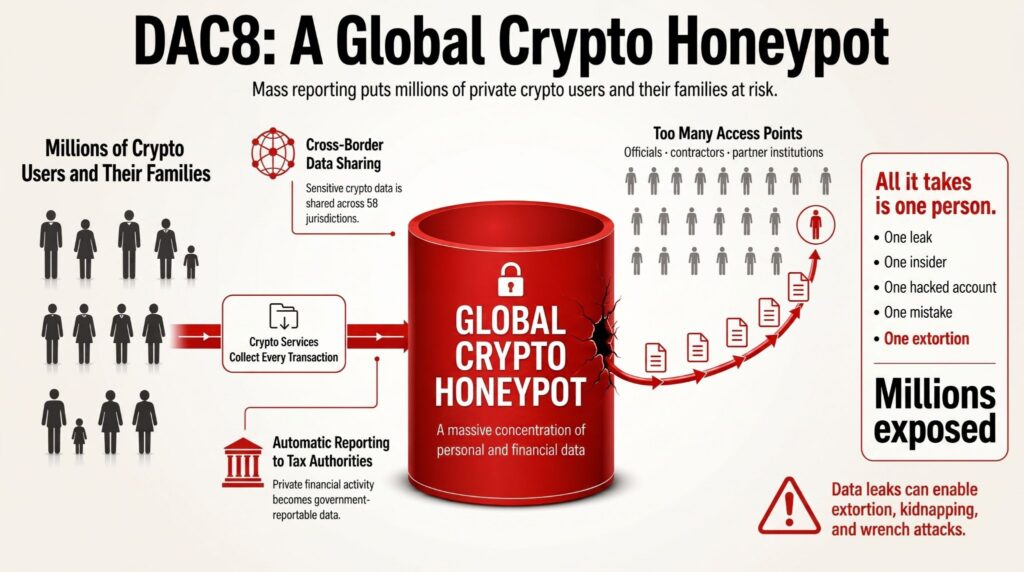
Bull Bitcoin posits that the DAC8 transforms the inherent incentive for companies to protect user data into a highly valuable multinational database, often referred to by cybersecurity experts as a honey pot. The organization emphasizes that regulated crypto-asset service providers (CASPs) under MiCA, DORA, and the GDPR are held to professional standards with financial incentives to safeguard their customers. In contrast, DAC8 redirects data into expansive administrative reporting networks, leading to broader access and diminished accountability for users. Bull Bitcoin concludes that the overall security of this system is only as robust as its weakest link.
Historical data security trends reveal significant challenges in accumulating and protecting user information securely. Notably, this year, the French National Agency for Secure Credentials (ANTS, also known as France Titres) experienced a significant data breach detected on April 15, 2026, affecting between 11.7 to 19 million accounts. Exposed data included login credentials, names, email addresses, birth dates, account identifiers, and, in some cases, physical addresses, places of birth, and contact numbers.
Earlier, the French National Bank account registry suffered a significant attack, compromising data related to approximately 1.2 million accounts. Compromised information included IBANs, account holder names, addresses, and, for some accounts, tax identification numbers, although officials indicated the auditor could not access balances or execute transactions.
In the United States, the situation mirrors these challenges. The Equifax Data Breach of 2017 affected 147 million individuals, while the National Public Data Breach of 2024 compromised data for over 200 million Americans, including exposure of critical information such as Social Security numbers. Additionally, in 2015, the U.S. government’s Office of Personnel Management was breached, resulting in the theft of extensive personal data, including Social Security numbers and medical records.
The occurrences of such breaches are numerous, leading to a clear implication: the lesser the quantity of user information retained in these so-called honey pots, the more secure individuals will be, as all these data breaches expose civilians to risks, ranging from physical threats to identity theft.
Impacts on Families
Among the numerous concerns raised by Bull Bitcoin and documented on the DAC8 website, one of the most sobering is the potential harm to individuals who may not have purchased cryptocurrencies but are nonetheless associated with crypto users. According to data from Certik, Bull Bitcoin highlights that over half of the violent incidents reported in 2026 against cryptocurrency owners involved family members—including spouses, children, or elderly parents—as either direct victims or leverage over the key holders. Bull Bitcoin asserts that “DAC8 consequently exposes not only crypto-asset holders but also their entire immediate family; between 40 and 135 million Europeans are placed in a zone of physical risk, without any consent from them.”
Francis Pouliot, CEO of Bull Bitcoin, regards this intrusion into the privacy of Europeans as potentially catastrophic for the continent’s prosperity. He has characterized the DAC8 in stark terms, stating, “DAC8 has transformed the concept of Know Your Customer into Kill Your Customer.” He emphasized, “We cannot permit the erosion of the fundamental tenets of civilization through this assault on privacy rights. It is imperative that we delineate a firm boundary and refuse to surrender any further territory until nothing remains. It is incumbent upon someone to take a stance, and it appears that no one else is prepared and equipped to do so. Consequently, it falls to Bull Bitcoin to spearhead this movement.”
DAC8.com is a resource replete with facts, statistical data, official documentation (EUR-Lex, OECD, Legifrance), and analytical content, available in French, English, and other European languages for those wishing to engage with it and utilize it freely.

Thank you for visiting our site. You can get the latest Information and Editorials on our site regarding bitcoins.

