


Investor Ryan Cohen’s unsolicited $55.5 billion bid to acquire eBay through GameStop has captured significant attention within the corporate realm. On the surface, Cohen’s proposition appears enticing, promising a reduction of $2 billion in excess overhead and an immediate increase in eBay’s diluted GAAP earnings per share from $4.26 to $7.79 in the first year.
However, beneath the attractive veneer exists a considerable challenge: a speculative cash-and-stock structure necessitating the assumption of $20 billion in new debt from TD Securities, alongside considerable dilution of GameStop’s own shares to purchase a corporation four times its size. The cautious outlook of analysts and investors is evidenced by eBay’s stock trading consistently below Cohen’s proposed $125 price per share.
The board of eBay need not depend on a smaller, meme-driven retailer to identify efficiencies by aggressively trimming its budget. Instead, they have the opportunity to pursue a proven strategy demonstrating that genuine operational efficiency emerges not from cuts to marketing budgets, but from enhancements to their payment infrastructure.
By adopting insights from the broader digital asset ecosystem and examining the transformative business model executed by the established brand Steak ‘n Shake, eBay can achieve significant structural improvements on its own terms.
The Proof of Concept: The Steak ‘n Shake Case Study
The implementation of Bitcoin Lightning Network payments by Steak ‘n Shake was not merely a promotional strategy. The tangible results fundamentally altered corporate retail finance dynamics:
- 50% Fee Savings: Leadership at Steak ‘n Shake confirmed that using the decentralized Bitcoin Lightning protocol cut their payment transaction costs by half, compared to traditional credit card networks.
- The Strategic Reserve: Rather than converting these savings back to fiat currency, they redirected the capital into a Strategic Bitcoin Reserve to reward employees, creating a self-sustaining financial cycle.
The Opportunity Cost: What This Math Means for eBay
The Payments Blindspot
As a titan of e-commerce, eBay operates on a vast scale in its global marketplace. In its fiscal year 2025 financial results, eBay reported steady growth; however, it remains tethered to outdated payment systems. Operating its own internal payment infrastructure (eBay Managed Payments) places eBay in a position of bearing substantial transaction fees from traditional credit card networks, which are, in turn, passed on to sellers through a significant ~13.25% take-rate.
While eBay maintains confidentiality about its precise net processing fees, traditional credit card networks (Visa, Mastercard, Amex) typically charge digital merchants an average global interchange and processing fee ranging from 2.5% to 3.5%.
Assuming a standard 3% merchant legacy swipe fee across its substantial $80 billion volume, emulating Steak ‘n Shake’s demonstrated 50% reduction in processing costs reveals a staggering annual opportunity cost currently borne by eBay:
- $80B (Annual GMV) x 3% (Estimated Legacy Swipe Fee) = $2.4B in Friction
- $2.4B x 50% (Lightning Efficiency) = $1.2B Annually
The Treasury Blindspot
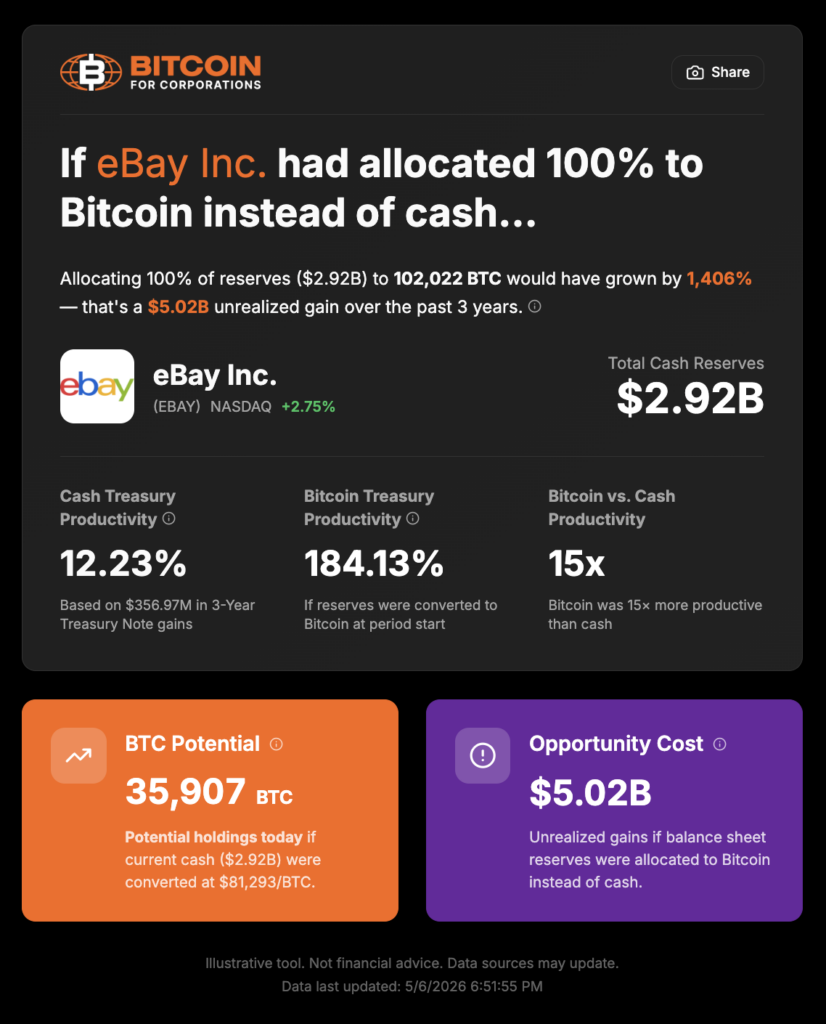
While eBay has allowed its $2.92 billion in cash reserves to remain idle in low-yield traditional treasury instruments (yielding merely 12.23%), the cost of overlooking Bitcoin over the past three years has resulted in a multi-billion dollar oversight in the boardroom.
Had eBay’s board allocated the entirety of those reserves to Bitcoin instead of fiat cash, the treasury could have expanded by a remarkable 1,406%, representing a $5.02 billion unrealized gain left unutilized.
 Utilize the Bitcoin Treasury simulator.
Legacy Credit Card Rails vs. The Bitcoin Lightning Network
Rather than allowing a leveraged buyout to dictate its trajectory, the integration of a native crypto payment solution would permanently enhance eBay’s economic structure in favor of its 135 million active users [1.1].
3 Reasons Why the Payment Strategy Surpasses Cohen’s Takeover
1. It Protects Shareholders from Volatile Corporate Debt
Cohen’s proposal necessitates the creation of an unverified $20 billion financing letter and reliance on the unpredictable nature of meme-stock equity to facilitate the acquisition. In contrast, the integration of a decentralized payment protocol incurs negligible implementation costs for eBay and naturally expands profit margins without exacerbating corporate leverage.
2. It Empowers eBay’s Core Asset: The Sellers
Cohen aims to extract value by significantly trimming $1.2 billion from eBay’s sales and marketing budget. Conversely, an integration of advanced payment systems seeks to extract value from financial institutions. By passing substantial fee reductions back to sellers, eBay creates a compelling incentive for them to exclusively list their premier inventory on its platform, rather than transitioning to independent storefronts or competing marketplaces like Amazon.
3. It Automatically Dominates the Collectibles Market
A central tenet of GameStop’s acquisition strategy is to utilize its 1,600 storefronts as physical hubs for authenticating trading cards and luxury items. However, the premium collectibles market is already closely associated with digital asset wealth. Enabling global buyers to purchase high-end items, such as luxury watches or rare comics, using Bitcoin facilitates access to a vast realm of highly liquid international capital that a physical retail presence cannot replicate.
The Ultimate Counter-Punch
GameStop’s pursuit of eBay stems from its perception of the platform as a substantial revenue-generating entity that has fallen behind technologically. Rather than permitting a smaller competitor to heavily leverage itself for a takeover, eBay’s board has the opportunity to render GameStop’s cost-reduction narrative obsolete.

Thank you for visiting our site. You can get the latest Information and Editorials on our site regarding bitcoins.

