


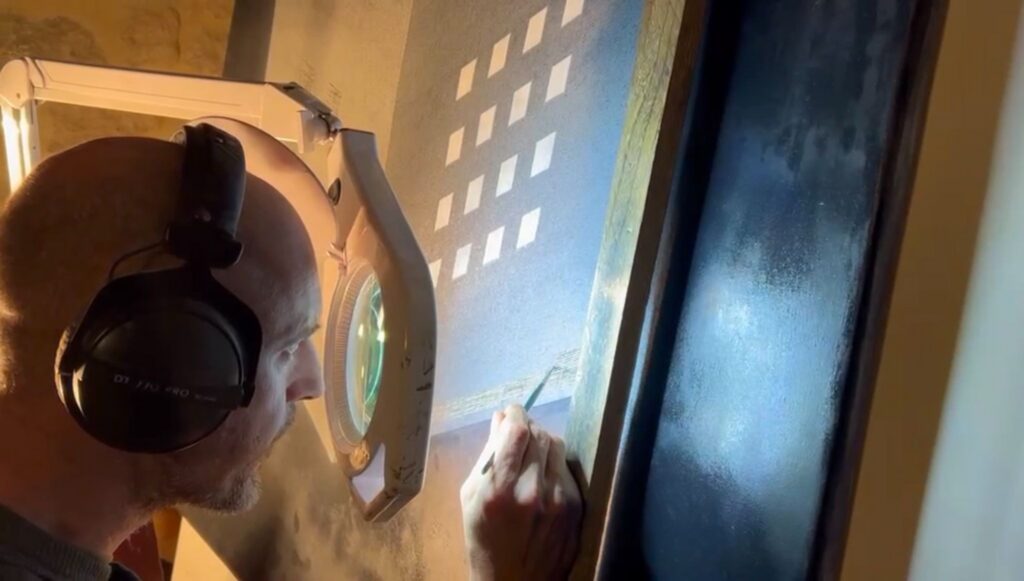
Bitcoin’s supply is capped at 21 million, a figure that is both immutable and encoded within its protocol. This finite limitation represents one of the most significant design choices in monetary history. However, for many, this number exists merely as an abstraction—green digits cascading across a black screen, reminiscent of a scene from The Matrix, or a topic for discussion on a podcast.
Japanese artist On Kawara dedicated nearly fifty years to the daily task of hand-painting a date onto a canvas, discarding any work not completed by midnight. Anik Malcolm, in contrast, invested 900 hours into meticulously painting 21 million beads. Both artists share a similar impulse: to transform abstraction into a tangible form, allowing the act of counting to gain significance and the labor involved to convey meaning.
“The Entire Universe” is a concept first conceptualized in early 2025 and has now evolved into its third—and most ambitious—iteration: a large-format oil painting where each bitcoin is represented by an individual bead, painstakingly painted over the course of 900 hours. This work is scheduled to debut at Bitcoin 2026 at The Venetian Resort in Las Vegas.
The initial premise was straightforward: visually represent 21 million of something. However, the methodology revealed complexities akin to a tesseract, a shape that seems to unfurl more dimensions the longer one observes it. Notably, 21 million does not yield a clean cube; its cube root is an irrational number. When rounded to the nearest whole number, 276, and cubed, it results in 21,024,576—exceeding 21 million by precisely 24,576. This surplus can be evenly divided by six (one for each face of the cube), leading to the removal of 4,096 beads on each side. The square root of 4,096 is 64—a perfect square and a power of two—allowing for continual halving, which mirrors the halving mechanism inherent to bitcoin.
Malcolm observed a pattern that was instinctively present. For him, the artwork transcends mere representation of Bitcoin; it serves as a still life of the concept itself. This depiction has garnered attention from figures such as Adam Back.
From initial sketches showcased in Lugano to digital renderings, culminating in the oil painting debuting at Bitcoin 2026—and plans for a monumental public sculpture in Roatán—“The Entire Universe” continues to demand a grander canvas.
The author engaged in a dialogue with Anik Malcolm to explore how a seemingly simple question led to an extraordinary creative journey.
BMAG: “The Entire Universe” originated from a deceptively straightforward premise: create an artwork that illustrates 21 million of something. What inspired this idea, and how did your wife, an artist and jeweler herself, propose the concept of a cube of beads? How does this kind of creative exchange work between you both?
Anik Malcolm: The original inspiration was indeed as simple as it appears. It struck me that while the 21 million figure is critically significant to bitcoin enthusiasts, it is also challenging to comprehend without a visual representation. This number is simultaneously immense and yet relatable in scale, so my objective was to animate the number, making it more accessible. My wife, Una, and I have collaborated on various projects in both visual and sonic arts, which has cultivated a constructive dynamic between us. I shared my idea with her, and her immediate response was “a cube of beads.” This concept resonated, as a cube is a prevalent symbol associated with bitcoin, both visually and metaphorically, and beads represent one of the earliest forms of currency—making it a logical and manageable combination. I quickly began working on the practicalities, calculator in hand, and was astounded by the results!
BMAG: As you explored whether 21 million could be arranged within a cube, you encountered a series of mathematical coincidences—including 276 cubed and the 4,096 remainder evenly divisible by six. The square root yielding 64, a power of two. Can you describe that moment? Did the significance of your findings become evident immediately, or did it develop gradually?
Anik Malcolm: Indeed, that realization came upon me quite rapidly. I understood from the outset that the cube root of 21 million wouldn’t yield a rational number, necessitating some adjustments to make it fit. Starting with rounding up to 276 enabled me to arrive at 21,024,576, generating a thrill when the surplus of 24,576 divided evenly by six — ensuring the structure’s symmetry. However, the excitement amplified considerably when I discovered the square root of 4,096. Inputting “square root of 4096” into my calculator left me momentarily speechless, with Una watching in amusement. The ability to evenly distribute the subtracted number across all six sides while maintaining perfect squares to arrive back at 21 million felt almost divinely orchestrated, suggesting a deeper significance encoded from the beginning, waiting to be unearthed. I knew instantly that I was entrusted with a substantial and meaningful project.
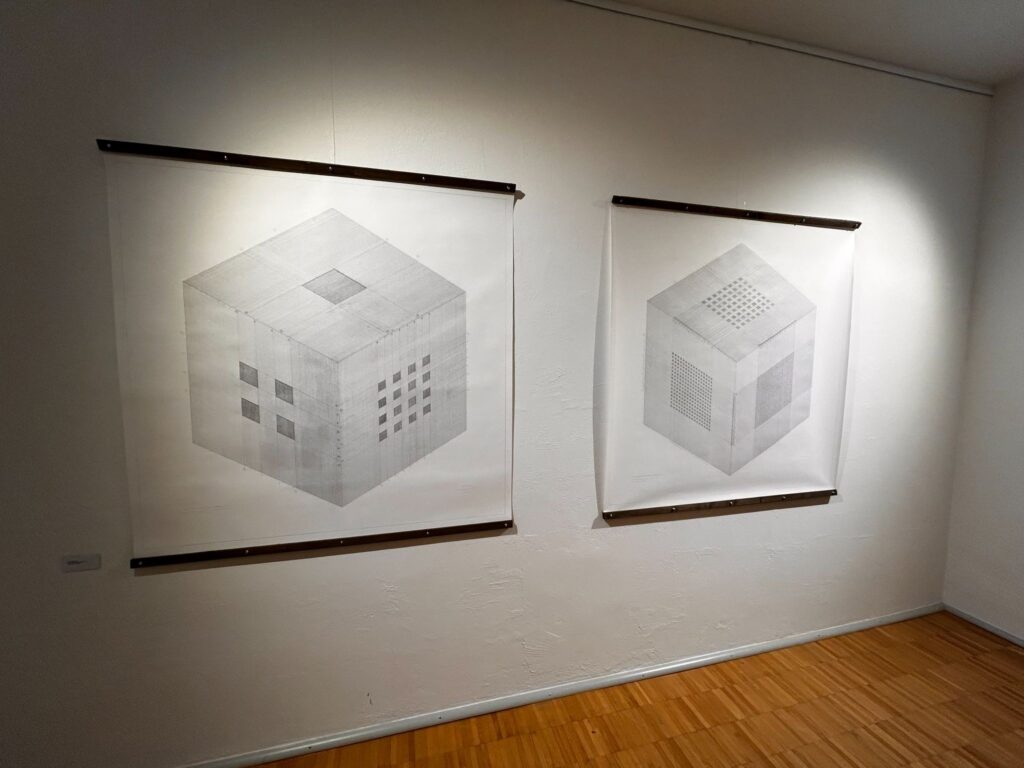
BMAG: The pattern you discovered—squares halving from 64×64 down to 2×2—reflects bitcoin’s halving mechanism. You have referred to this piece as a “still life of Bitcoin.” To what extent did you intentionally search for that connection, and how much felt inherent and waiting to be revealed?
Anik Malcolm: Initially, I was deeply moved by the discovery, and it was only later that I realized, to my greater astonishment, that I could further divide 64 into 32, 16, 8, 4, and 2. This not only enhanced the visual appeal of the cube but also represented both the halving function vital to bitcoin’s mechanism and the exponential growth that arises as a direct consequence. It seemed that this single cube encapsulated everything bitcoin embodies, encompassed in a strikingly symmetrical elegance. I remain captivated by this conceptual beauty, which is why I have committed significant time to this work—at least for now. To summarize, I did not set out to find these connections; rather, I feel like a messenger, indicating that my role is one of revelation rather than invention.
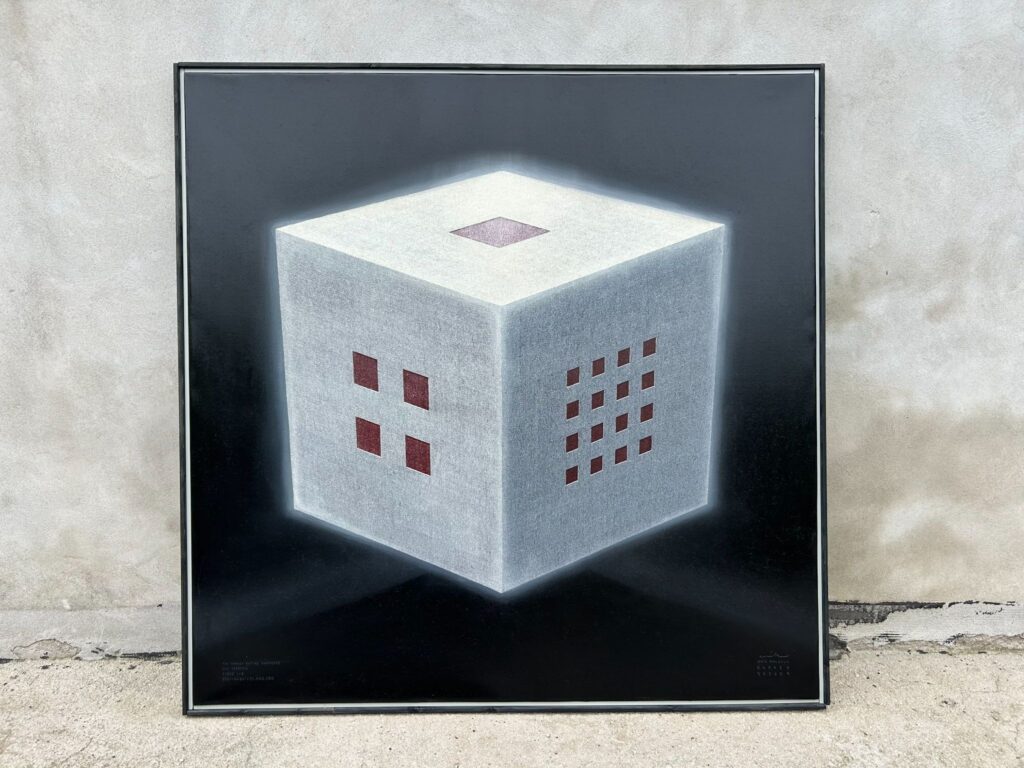
BMAG: The oil painting, which took over 900 hours to complete, features 227,701 visible beads, each representing an individual bitcoin, painted by hand. How does such extensive, meticulous labor influence your relationship with the subject? Does spending that amount of time with the number 21 million alter your perception of it?
Anik Malcolm: This is an intriguing question that I contemplated extensively throughout the process. As a two-dimensional representation of what is theoretically a three-dimensional object, I “only” had to paint 227,701 visible beads—each bead requiring three applications: the body, highlight, and shadow, alongside the underlying grid.
The entire undertaking was profoundly meditative. I found that distracting thoughts impacted my efficiency, leading to an exercise in recognition, acceptance, and letting go—a personal growth journey akin to many experiences reported by individuals on their bitcoin journeys.
Over time, I also recognized that music needing more concentration affected my focus negatively, prompting me to curate a playlist resonating with the cube’s essence. This included composers such as Arvo Pärt, David Lang, and Kjartan Sveinsson, which I will share at Bitcoin 2026, adding another layer to the artwork’s presence.
Furthermore, I began noticing various patterns within the numbers, some aligning with Tesla’s “3, 6, 9” concepts, and I spontaneously found myself reciting personal mantras while painting, dot by dot, in a 3, 6, 9 sequence!
Ultimately, rather than imposing meaning on the number and its cubic form, I became profoundly influenced by it as time progressed—physically, mentally, and spiritually. There exists a sense of “holiness” in bitcoin that I believe resonates with many of us. Thus, my experience of representing it so literally served as a genuine expression of that sentiment.
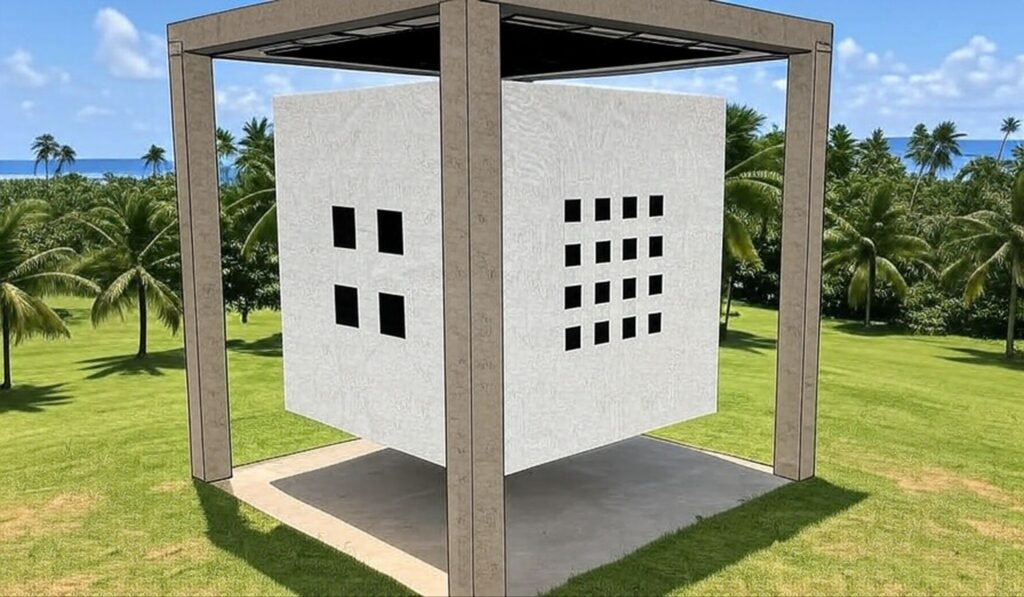
BMAG: This concept has evolved from drawings in Lugano to digital iterations and tutorial videos to a large-scale oil painting, with plans for a monumental public sculpture in Roatán. What is it about this particular idea that necessitates increasingly expansive formats?
Anik Malcolm: Interestingly, both the Lugano drawings and the Bitcoin 2026 painting (each measuring 128×128 cm, or about 4’2″) are at the smallest feasible scale to accurately convey the number. Each bead measures 2 mm (5/64″), and reducing the size further would prove unmanageable. I also intend to create a sculpture of similar dimensions, ideally under 55.2 cm (approximately 2′) long, which remains manageable. Nonetheless, I encountered an individual in Lugano who had been searching for an appropriate concept for a monumental bitcoin sculpture in Roatán. We believed that this idea was perfectly suited for such a purpose. Even at a bead size of 1 cm (approximately ⅜”), with 1 cm spacing for visual and kinetic effects, the cube’s dimensions quickly expand to 5.52 m (approximately 18′), excluding the supporting structure and elevation. Experiencing all 21 million at such a grand scale would do justice to bitcoin and all it represents.
BMAG: Adam Back has taken an interest in this work. However, if a visitor approaches the painting at Bitcoin 2026 with no mathematical background or specific interest in bitcoin’s technical architecture, what do you hope they will see or infer?
Anik Malcolm: I believe my teenage daughter represents that demographic effectively. She recently mentioned that she often enters the room where the painting is drying “just to look at it for a while.” During my painting process, I noticed that the cube’s symmetry and patterns have a deeply calming effect, especially when combined with the curated soundtrack. The experience becomes meditative and engrossing. Furthermore, there are 21 visible subtracted squares on the painting—another beautiful coincidence referencing the subdivisions: 1 square of 64², 4 squares of 32², and 16 squares of 16². My hope is that both attendees at Bitcoin 2026 and the eventual owner of the painting will derive profound and lasting pleasure from the tranquility that was subtly encoded within that mystical number—akin to the calm, methodical truth inherent to the bitcoin experience as a whole.
Fix the money. Fix the world.
“The Entire Universe” by Anik Malcolm will debut in the Bitcoin Museum & Art Gallery at Bitcoin 2026, taking place from April 27–29 at The Venetian Resort, Las Vegas. To preview the work and explore more from the Bitcoin 2026 exhibition, click HERE. A limited-edition shirt inspired by the painting is available HERE.
The Bitcoin Museum & Art Gallery (BMAG) operates as the curatorial and cultural programming division of BTC Inc and the Bitcoin Conference. Since 2019, the BMAG conference art gallery has facilitated sales exceeding 120 BTC in art and collectibles. For more information about BMAG, visit museum.b.tc and follow on Twitter @BMAG_HQ.
Bundle your Bitcoin 2026 pass with accommodation at The Venetian and receive your fourth night free. Use code AFTERS for a complimentary After Hours Pass, or obtain your pass alone here.

Thank you for visiting our site. You can get the latest Information and Editorials on our site regarding bitcoins.

